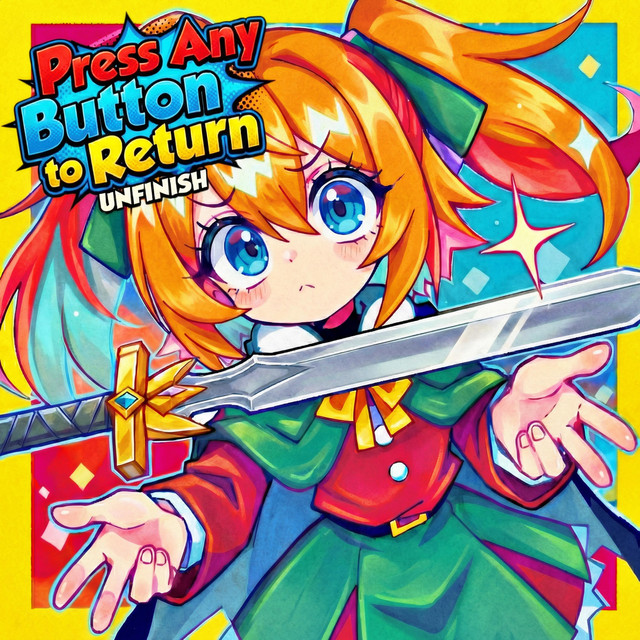
Behind 'Press Any Button to Return': The Loading Screen as an Emotional State
February 27, 2026· 6 min read· 196 views
"Press Any Button to Continue" is one of those phrases so embedded in gaming that it stopped being words a long time ago. You see it and your hand moves automatically. You don't read it. You respond to it.
This track changes one word. Not Continue — Return.
That's the whole song.
The Difference One Word Makes
Continue implies forward motion. The game is paused, you're resuming, you're going somewhere. Return implies going back. Back to what, exactly? The question is what made the title interesting enough to build a track around.
Loading screens in games are transition spaces. You've finished something and you're waiting for the next thing to load. In that gap — ten seconds, thirty seconds, two minutes — you're technically in neither place. Not in the level you left, not in the level you're entering. Just waiting in a liminal space that exists entirely to be passed through.
Most people pass through it without stopping. Some people sit in it. This track is for the second group — and specifically for the moment when "Return" starts to feel like a question about something beyond the game.
Writing Music for a Non-Space
The production challenge was obvious once I named it: how do you write music that sounds like being in between? Not building toward something, not releasing from something — genuinely suspended.
The answer was texture over movement. The track has elements that would normally function as tension-building or resolution, but they're placed in a way that doesn't let either fully occur. The builds don't quite peak. The drops don't fully release. You're always at the edge of a transition that keeps not happening — which is exactly the loading screen experience extended into sound.
This is harder to do than the reverse. Writing music that builds and releases is intuitive; the body knows where it wants to go and you follow. Writing music that sustains indefinite suspension requires constant resistance against your own instincts. Every time I wanted to let a phrase resolve, I had to hold it back and find something else to do with the energy instead.
There are points in the track where the production feels like it's about to open up completely — and then doesn't. Those are the moments I'm most attached to. The gap between expectation and delivery is where the emotional content lives.
What "Return" Actually Means
During production, I kept asking myself what returning means after enough time has passed that things have changed. You can go back to a place. The place has been renovated. You can go back to a relationship. Both people are different now. You can go back to a version of yourself. It doesn't quite load.
The loading screen "Return" prompt is benign in context — press this to go back to the main menu. But stripped out of context, the phrase carries weight. Return implies there's something to return to, and that you're capable of returning to it, and that it will be recognizable when you get there. All three of those assumptions are sometimes wrong.
The track doesn't resolve the question. It holds it. The suspension in the production is the suspension of the question — not knowing what you're returning to, not knowing if you can, pressing the button anyway because the screen is prompting you and you don't have a better option.
The Gaming Language That Isn't About Gaming
I make music for games. STIGMA: Unnamed runs on an UNFINISH soundtrack. The relationship between the music and gaming isn't incidental — it's foundational to how I think about production. But the tracks that work best aren't ones that are about gaming as a surface aesthetic. They're ones where the emotional logic of gaming maps onto something human underneath.
The loading screen is a perfect example. Everyone who has played a game knows what it feels like — that suspension, that waiting, that particular quality of being nowhere for a moment. But that experience isn't really about games. It's about transition. About being between states. About the weird emotional territory of ending something and not yet having started the next thing.
That emotional territory has nothing to do with controllers and everything to do with being a person who moves through time, ends things, and has to start again. The gaming language is a vehicle. The destination is something else entirely.
The One Take That Made It
There's a melodic element in the second half of the track that almost didn't make it into the final version. It came from a session where I was experimenting with something unrelated and hit a sequence by accident. I exported it immediately without touching anything else — there's a superstition in production, probably well-founded, that if you start adjusting an accidental discovery you destroy what made it work.
That sequence became the emotional spine of the back half of the track. The rest of the production is built around holding space for it — which is maybe the right metaphor for the whole song. You're not building toward it. You're just making room for it to arrive.
Listen Now
Spotify · Apple Music · YouTube Music
FAQ
What is "Press Any Button to Return" about?
The track takes the gaming loading screen prompt and changes one word — from "Continue" to "Return" — to shift the emotional register. Where Continue implies forward motion, Return implies going back to something. The production mirrors the loading screen experience itself: suspended between states, neither building toward a climax nor releasing from one, holding a question that doesn't resolve. It's about transition, and about the uncertainty of what you're returning to when enough time has passed that things may have changed.
Why is the production structured around suspension rather than tension and release?
The emotional target was the loading screen as a space — genuinely in between, not building toward something or releasing from something. Builds that don't quite peak, drops that don't fully release, phrases that approach resolution and then don't take it. The gap between expectation and delivery is where the emotional content of the track lives. Writing sustained suspension requires constant resistance against the instinct to resolve, which made it one of the more technically demanding tracks to finish.
How does gaming language connect to non-gaming emotions in this track?
The loading screen experience — suspension, waiting, being between states — maps onto a broader human experience of transition. Ending something and not yet having started the next thing. Going back to a place that's been changed. Returning to a version of yourself that doesn't quite load. The gaming language is specific and recognizable, but it's a vehicle for something that has nothing to do with controllers. The emotional territory is about moving through time and having to start again.
What is the melodic element in the second half and how was it found?
It came from an accident — a sequence hit during an unrelated session that was immediately exported without adjustment. Accidental discoveries in production tend to lose their quality when you start editing them; they work because of some combination of factors you didn't control, and touching them often destroys exactly that. The rest of the production in the second half is built around creating space for this sequence to arrive rather than building toward it.
Related Posts

Behind 'Cold Summer': What a Season Feels Like When It's the Wrong Temperature
Mar 8, 2026

Behind 'Spellbound': What It Means to Make Something Hypnotic
Mar 5, 2026
Behind 'Heavy Hitter': Making Something That Hits Without Trying to Hit
Mar 5, 2026
Behind 'HiJinK 2': Why Sequels Are a Bad Idea (And Why I Made One Anyway)
Mar 1, 2026
Sign in to leave a comment
Loading...