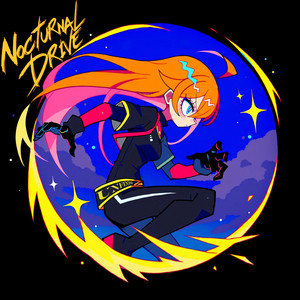
Behind 'Nocturnal Drive': Making a Track That Moves at 3 AM
February 24, 2026· 5 min read· 158 views
There are tracks you make during the day and tracks you make at night. The difference is audible.
Nocturnal Drive is unambiguously the second kind. It was written almost entirely between midnight and 4 AM over the course of about a week. Not because I work better at those hours — I don't, really — but because the track seemed to require them. Every time I tried to work on it in the afternoon, something felt off. The energy wasn't right. The reference point didn't exist yet.
The reference point is driving at night in a city. Not going anywhere specific. Just moving.
Where the Concept Came From
I was in a period where I was spending a lot of time in cars late at night. Not going anywhere productive. Just driving to decompress — something I've done since I was old enough to drive. There's a specific mental state that happens when you're moving through a lit city at 2 or 3 AM. The city looks different. The stakes feel lower. Everything is still there but none of it is demanding anything from you right now.
That state is genuinely hard to recreate in music because it's not an emotion exactly. It's more like an atmospheric condition. There's movement in it, some wistfulness, a little adrenaline, but mostly just presence. The feeling of being somewhere and having no particular obligation to be anywhere else.
I wanted to make something that felt like that without being literal about it. No car sounds, no city ambience samples. Just the emotional texture of the thing.
"The city looks different at 3 AM. The stakes feel lower. Everything is still there but none of it is demanding anything from you."
Building the Movement
The biggest challenge in producing Nocturnal Drive was creating a sense of forward momentum without it feeling urgent. Driving at night isn't rushed. You're not trying to get somewhere fast. But you're not still either. There's continuous, unhurried motion.
Musically, that meant the tempo had to be exactly right — fast enough to feel like movement, slow enough to feel like night. I went through probably eight or nine BPM variations across a 15-beat range before landing on something that worked. A few BPM in either direction and the whole texture changes. Too fast and it's daytime. Too slow and you're parked.
The bassline carries most of the motion. It's the thing that keeps moving when other elements drop out. I spent more time on the bass for this track than on almost anything else in the arrangement because it was doing the most structural work. Everything else is atmosphere. The bass is the road.
The Synth Choices
Nocturnal Drive uses a specific palette of synthesizer textures that I associate with city light at night — bright at the edges, dark in the spaces between. This is easier to describe than to produce.
What I was going for technically: sounds that have a clean, almost metallic brightness on the attack that fade into something softer and more diffuse. The decay and release shapes were as important as the oscillator choices. Too sharp an envelope and everything feels clinical. Too soft and it loses the city edge.
There's also a deliberate use of space in this track — gaps in the mid-frequency range that let the low end breathe. In practice this means being selective about what occupies the 300-800 Hz range, which is where most of the warmth lives. Cutting some of that creates a cooler, more nocturnal quality. It sounds like less but it doesn't feel like less.
The Structural Choice That Defines the Track
Nocturnal Drive has a long introduction by the standards of what I usually make. It takes almost ninety seconds to reach what you'd call the main section. A few people told me early on that it was too slow to build.
I disagree, and I kept it. The introduction is doing something specific: it's establishing a place before it establishes a song. If you get in a car and start driving immediately without a moment where you're just sitting there with the engine running, you skip something. The intro is the moment you're still parked. Everything that follows is the drive.
Structurally, the back half of the track mirrors the front but with the textures more developed. It's not quite a traditional drop — there's no dramatic buildup and release — but there's a density change that feels like moving into the faster part of the route, when the lights are fewer and you can actually accelerate.
What I'd Do Differently
There's a high-frequency element that comes in about two-thirds through the track that I've gone back and forth on. In some listening environments it sits perfectly. In others it's slightly too present.
If I were finishing Nocturnal Drive today, I'd probably handle that element differently — either pull it back or change the frequency shaping so it reads better across more playback systems. It's one of those things you notice after the track is out, when you've heard it in enough different contexts to understand where the decisions didn't generalize well.
The core of the track I'd keep exactly as it is.
Listen Now
Spotify · Apple Music · YouTube Music
FAQ
What is Nocturnal Drive about?
It's about a specific feeling: driving through a city late at night with no particular destination. The emotional texture of movement without urgency. The track was made almost entirely between midnight and 4 AM because those hours held the reference point the music needed.
Why does the track take so long to build?
The long introduction is intentional. It's establishing a place before it establishes a song — the moment you're still parked with the engine running before you actually start moving. Cutting it would skip something that the track requires structurally.
How was the sense of forward motion created without sounding rushed?
Primarily through the bassline, which carries continuous movement when other elements drop out. Tempo was also critical — the BPM range was tested extensively to find a speed that reads as movement without urgency. A few BPM in either direction changes the whole feel. The bass is the road.
What would you change about Nocturnal Drive today?
One high-frequency element in the latter third of the track doesn't generalize well across different listening environments. That would be handled differently today. The rest of the track stays as is.
Related Posts

Behind 'Cold Summer': What a Season Feels Like When It's the Wrong Temperature
Mar 8, 2026

Behind 'Spellbound': What It Means to Make Something Hypnotic
Mar 5, 2026
Behind 'Heavy Hitter': Making Something That Hits Without Trying to Hit
Mar 5, 2026
Behind 'HiJinK 2': Why Sequels Are a Bad Idea (And Why I Made One Anyway)
Mar 1, 2026
Sign in to leave a comment
Loading...